
Posterior segment of the eye
Retinal & Vitreous Conditions
Changes that may cause floaters, flashes, blurred vision or sudden loss of part of the visual field — and in some cases require urgent assessment.
Symptoms
Flashes & floaters
Urgency
Shadow or “curtain”
Assessment
Dilation & imaging
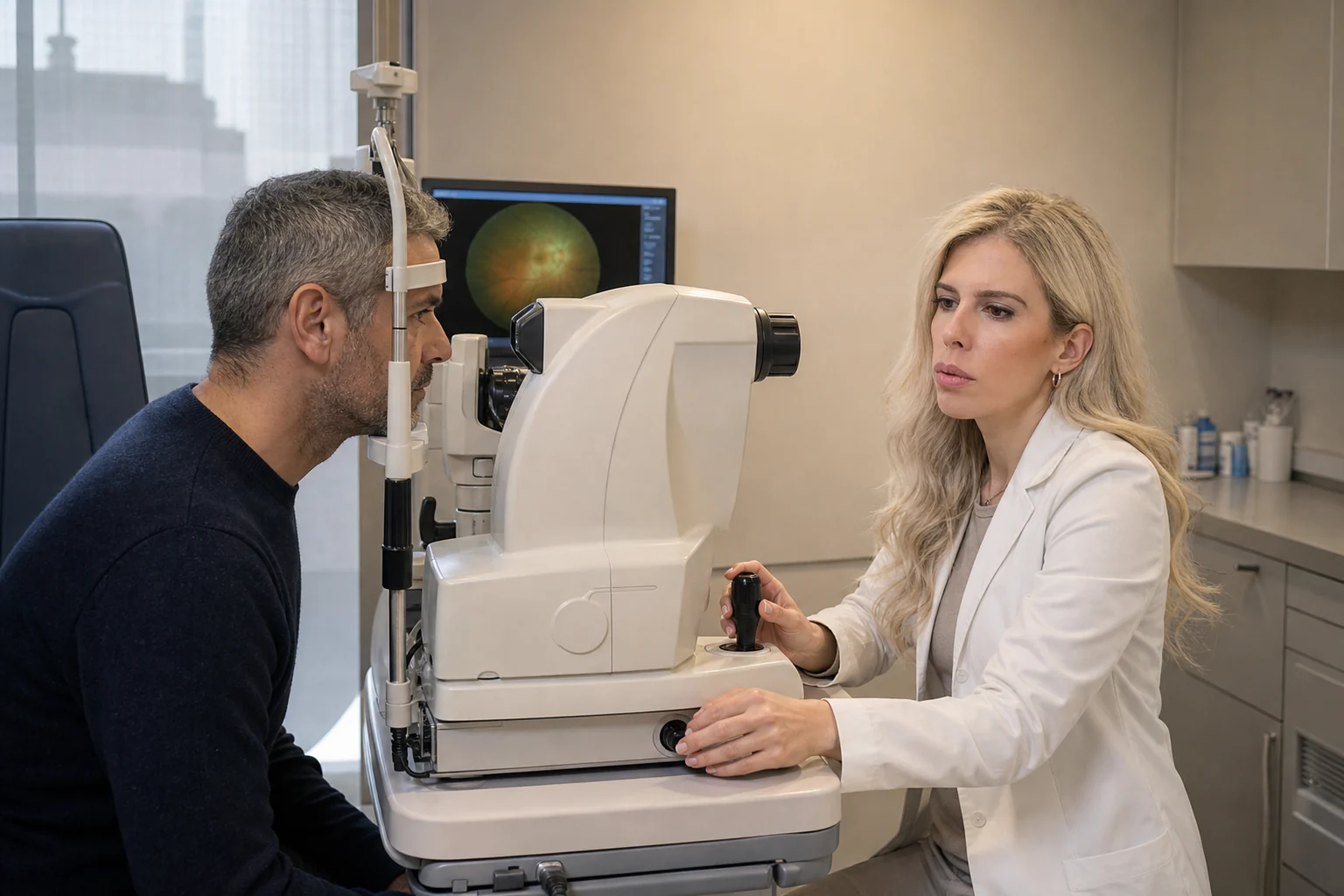
Fundus of the eye
Retina
Two critical structures
The light-sensitive tissue and the transparent interior of the eye.
The retina is the light-sensitive tissue at the back of the eye, while the vitreous is the transparent, gel-like substance that fills the inside of the eye.
Conditions and changes affecting these structures may cause floaters, flashes, blurring, distortion, loss of part of the visual field or a sudden reduction in vision.
The speed at which symptoms develop and the appearance of the peripheral retina determine how urgently assessment is required.
A sudden increase in floaters or new flashes requires examination to rule out a retinal tear or another retinal complication.
Conditions covered
From a peripheral tear to vascular damage.
Each condition has a different course and degree of urgency. Diagnosis is based on the clinical findings and targeted imaging.
01 / URGENT
Loss of the normal position
Retinal Detachment
It may present with sudden flashes, many new floaters or the sensation of a shadow or “curtain” across the vision.
- An ophthalmic emergency
- Prompt assessment is important
- Planning the appropriate treatment
02 / PERIPHERY
Small openings or breaks
Retinal Tears
Some retinal tears may lead to detachment and may require preventive treatment.
- Dilated peripheral retinal examination
- Individual risk assessment
- Laser only when clinically indicated
03 / DIABETES
Damage to small blood vessels
Diabetic Retinopathy
There may be no symptoms in the early stages, which makes regular assessment particularly important.
- Fundus photography
- OCT or OCTA according to the findings
- Follow-up over time
04 / CIRCULATION
Obstruction of venous flow
Retinal Vein Occlusions
They may cause sudden blurring or reduced vision and often macular oedema.
- Retinal assessment
- Macular assessment
- Targeted follow-up
05 / VITREOUS
A common age-related change
Posterior Vitreous Detachment
Separation of the vitreous may cause a sudden increase in floaters or flashes.
- Assessment for an associated retinal tear
- Examination of the peripheral retina
- Follow-up advice
Symptoms
Warning signs that should not wait.
Sudden onset or rapid change has particular clinical significance.
A shadow or “curtain” in your visual field?
Seek urgent ophthalmic assessment — do not wait for a reply to an online form.
01
Many new floaters
A sudden increase in spots or moving shadows.
02
Flashes
Brief flashes of light, mainly in the peripheral vision.
03
Shadow or curtain
Loss of part of the visual field.
04
Sudden blurring
A significant new reduction in the clarity of vision.
05
Distortion
A change in shapes or straight lines.
06
Gap in the visual field
A new area that is no longer seen as before.
Sudden flashes, many new floaters or a shadow in your vision? Urgent ophthalmic assessment is required.

Dilated examination
Peripheral retina
Diagnosis & follow-up
Detailed fundus examination and targeted imaging.
The choice of tests depends on the symptoms and on whether direct visualisation is adequate.
01
Dilated fundus examination
Assessment of the retina and its periphery.
02
Digital fundus photography
Documentation of findings for recording and comparison.
03
Macular OCT
Imaging of the retinal layers and any fluid.
04
OCTA or angiography
Assessment of the retinal circulation when clinically indicated.
05
Ocular ultrasound
Used when direct visualisation of the fundus is inadequate.
Management
Management depends on the finding and its urgency.
From monitoring to laser treatment or surgery, the approach is selected only after a complete assessment.
01
Monitoring
For stable findings without an immediate indication for treatment.
02
Retinal laser treatment
May be used for selected retinal tears or vascular conditions.
03
Intravitreal treatment
Considered for specific conditions involving oedema or neovascularisation.
04
Surgical treatment
Required for certain retinal detachments or other serious changes.
The type and timing of treatment are determined by the diagnosis, location, extent and functional effect of the condition.
Frequently asked questions
Helpful answers.
General information that does not replace an individual medical assessment.
Do floaters always mean there is a retinal tear?
No. Floaters are common, but a sudden increase — particularly with flashes — requires examination to rule out a retinal tear.
Is retinal detachment an emergency?
Yes. A shadow, “curtain” or sudden reduction in vision requires urgent assessment.
Why is pupil dilation needed?
Dilating the pupil allows a more detailed examination of the fundus and peripheral retina.
Specialist assessment
Have you suddenly developed flashes, floaters or a shadow in your vision?
Seek urgent ophthalmic assessment. For urgent symptoms, call the practice directly and do not wait for a reply to an online form.
or call +30 697 421 2356
Medical information notice
This content is provided for general information and does not replace an ophthalmic examination, diagnosis or personalised medical advice.