
Individual refractive assessment
Refractive Surgery
Procedures intended to reduce dependence on glasses or contact lenses in appropriately selected candidates.
Aim
Reduced dependence
Starting point
Comprehensive assessment
Decision
Individualised
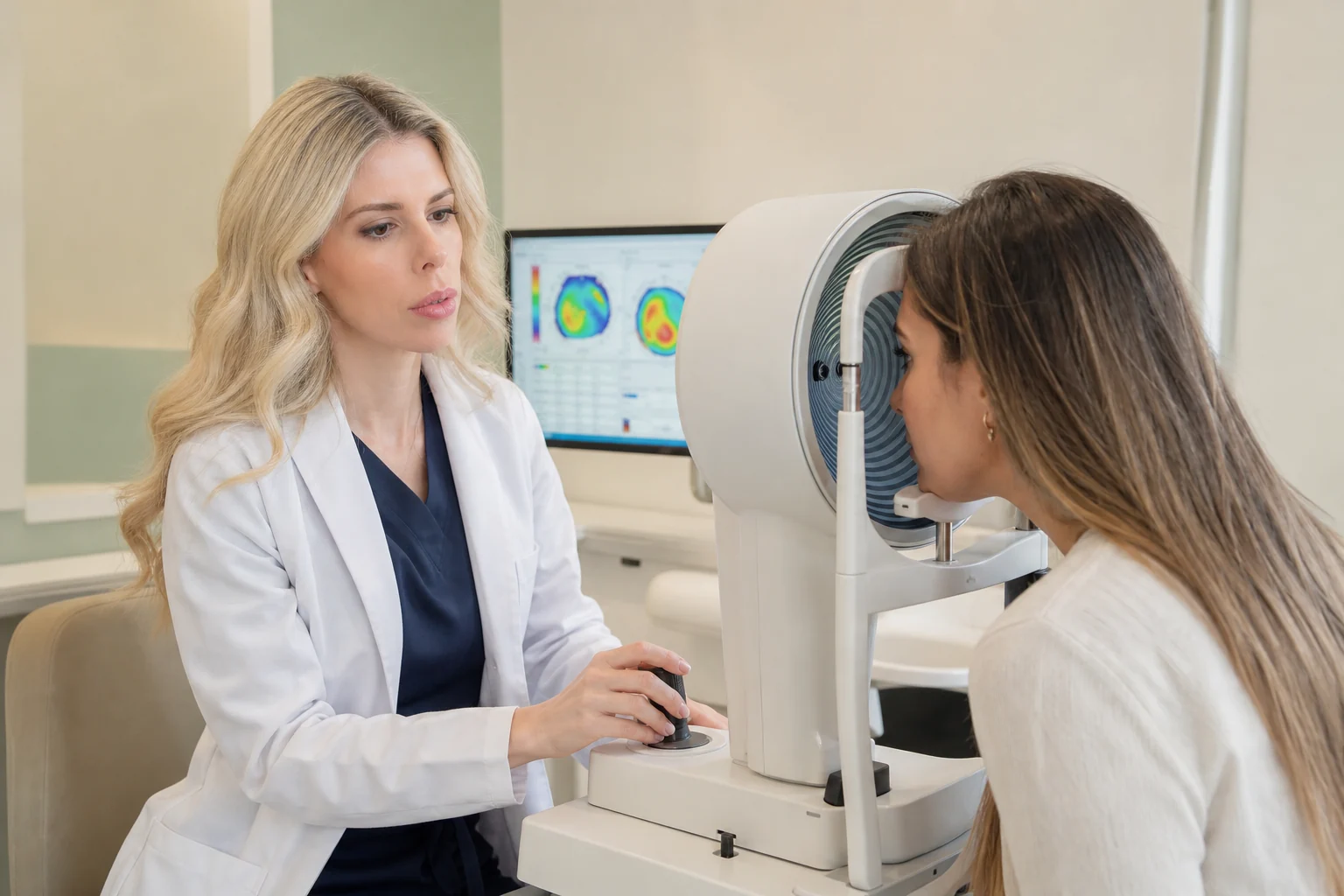
Precision before selection
Refractive assessment
The approach
We assess more than a prescription. We consider the whole eye.
Refractive surgery may correct myopia, hyperopia and astigmatism in appropriately selected candidates.
Suitability is not determined by the prescription alone. It requires a comprehensive review of eye health, corneal characteristics, refractive stability and individual visual needs.
The appropriate approach is selected after examination and a meaningful discussion of benefits, limitations and possible risks.
No online test can safely determine whether someone is suitable without a comprehensive ophthalmic examination.
Suitability
Candidacy is shaped by several factors.
A stable prescription is only the starting point. Age, general health and the anatomy of the eye are also considered.
01
Stable prescription
The assessment considers whether the prescription has remained stable over time.
02
Cornea
Thickness, shape and topographic characteristics must be appropriate.
03
Tear film
Dry eye or an unstable ocular surface requires assessment.
04
Retina
This is reviewed particularly in high myopia or where there is a relevant history.
05
General health
Pregnancy, autoimmune disease and medication may affect the decision.
06
Lifestyle
Occupation, activities and realistic expectations guide planning.
Pre-operative assessment
From precise measurement to the right choice.
The assessment maps refraction, the cornea, the ocular surface and the overall health of the eye.
01
Vision & refraction
Precise prescription measurement and visual-acuity assessment.
02
Corneal mapping
Keratometry and topography or tomography when available.
03
Thickness & surface
Pachymetry, tear-film assessment and review for dry eye.
04
Comprehensive review
Fundus examination, retinal assessment and discussion of visual priorities.
The final recommendation is based on the findings of the comprehensive assessment, not simply on the glasses prescription.
Options & expectations
The best technique is the one suited to the individual eye.
Different corneal laser techniques exist and, in selected cases, intraocular-lens solutions may be considered. The appropriate option is determined only after assessment.
01
Reduced dependenceThe aim is to reduce the need for corrective lenses, not to guarantee “perfect vision”.
02
Residual refractive errorA small refractive error may remain or develop later.
03
Presbyopia & quality of visionAge-related near vision, dryness, haloes and visual fluctuation are discussed in advance.
Corneal mapping
A decision based on clinical data, not on a promise.
The health of the macula, retina and optic nerve remains important to the quality of vision.

Personal planning
Realistic options
Expectations & considerations
Clear information before every decision.
The expected course and advice after treatment depend on the method and the individual case. Personalised information is provided beforehand.
01
Quality of vision
Possible dryness, haloes and visual fluctuation are discussed.
02
Future change
Presbyopia and refractive changes may require optical correction later.
03
Follow-up
Reviews and advice are determined by the method and the clinical course.
Contact the practice promptly after any procedure if you experience a significant reduction in vision, severe or increasing pain, or marked redness.
Realistic information
The aim is functional improvement, not an absolute promise.
There is no single technique suitable for everyone. Selection reflects the measurements, anatomy, refractive stability and individual needs.
Residual refractive error, presbyopia and possible adverse effects are discussed in detail before any decision.
Frequently asked questions
Helpful answers.
Brief answers that do not replace a comprehensive suitability assessment.
Can everyone have laser treatment for myopia?
No. Suitability depends on refractive stability, the cornea, eye health and general medical history.
Will I ever need glasses again?
Optical correction may be needed in future because of residual refractive error, age-related changes or presbyopia.
Which technique is best?
There is no single technique suitable for everyone. The choice follows a comprehensive pre-operative assessment.
Suitability assessment
Considering refractive surgery?
Arrange a specialist pre-operative assessment and a discussion of realistic options and expectations.
or call 697 421 2356
Medical information notice
This content provides general information and is not a suitability assessment or personalised medical recommendation.