
In this article
01 / Children’s vision
A child does not always realise that their vision is unclear.
Vision develops during the first years of life. When a difficulty affects only one eye or has been present from a young age, a child may regard the way they see as normal and may not mention a problem.
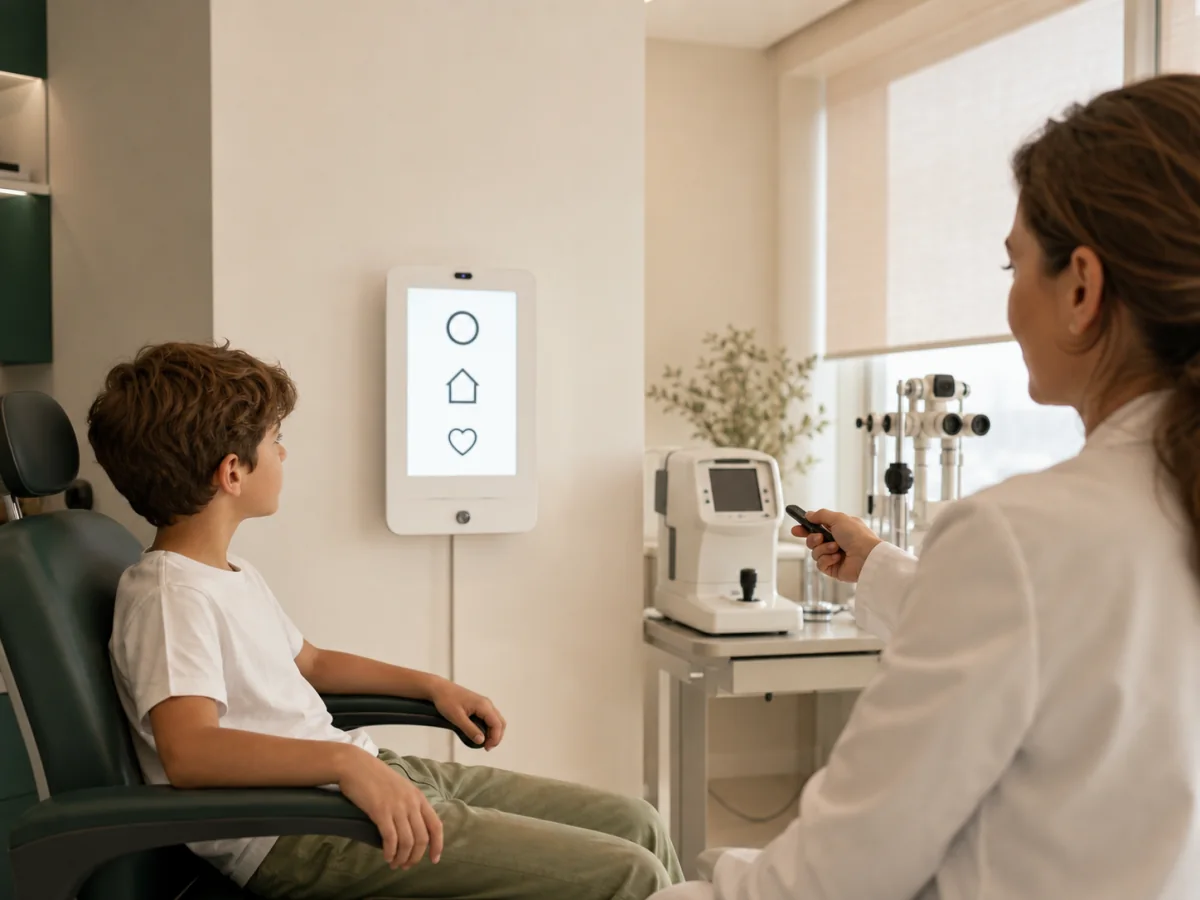
A preventive assessment helps evaluate visual development and identify findings that may need follow-up. A child does not need to know letters: the examination can be adapted using pictures, shapes, lights and objective measurements.
02 / Two different levels of assessment
Vision screening is not the same as a comprehensive eye examination.
Vision screening at school or in a paediatric clinic aims to identify children who may have a vision problem. A referral result is not a diagnosis; it means that a more detailed assessment by an ophthalmologist is needed.
A comprehensive examination assesses each eye separately and may include refraction, eye alignment and movement, and the health of the eye’s structures. Its exact content depends on the child’s age, history and level of cooperation.
Important: If a child cannot complete or does not pass a vision screening, the next step is a comprehensive eye assessment—not a conclusion based on the screening result alone.
03 / The examination
Four key areas of assessment.
The examination is organised as a calm sequence of short activities. It is not a test, and a child cannot “fail” it.
- Visual acuity using symbols, pictures or letters, depending on the child’s age.
- Refraction to assess myopia, hyperopia, astigmatism or a difference between the two eyes.
- Eye alignment, coordination and movement.
- Assessment of the eyelids, the front of the eye and, when indicated, the retina and optic nerve.
04 / What parents may notice
Behaviours worth discussing with the ophthalmologist.
A single behaviour does not establish a diagnosis. When it persists, recurs or appears alongside other findings, however, an assessment is advisable.
- Frequently closing or covering one eye, tilting the head or squinting.
- Holding books or screens very close, or finding it difficult to see the board at school.
- A visible or intermittent turn of one eye.
- Reporting blurred or double vision or headaches, or avoiding near-vision activities.
- Not completing or not passing a preventive vision screening.
Urgent assessment
An unusual white reflection in the pupil, an eye injury, a sudden change in vision or severe pain requires urgent medical assessment.
05 / Before the visit
The best preparation is simple and pressure-free.
Describe the visit as a chance to look at pictures, lights and special equipment. Avoid asking your child to “do well”, and bring any previous glasses, examination results or relevant information from school or your paediatrician.
The ophthalmologist will decide whether eye drops are needed for a more accurate refraction measurement or to dilate the pupils. The time required and the individual steps are not the same for every child.
Sources and further information
Medical information notice: This content is general and educational. It does not replace an individual diagnosis, a clinical examination or the advice of your treating ophthalmologist.